No friends allowed. 😤 Here's why.
My four-year-old asked for no friends at her birthday party. I almost dismissed it. Then a Wanderly story showed me what she was actually trying to tell me.
When our daughter turned four, she had one very specific request for her birthday party: a cake, a piñata, and no friends.
No friends.
I did what most parents would do. I smiled, assumed she was saying something silly, and kept planning the party anyway. She had a whole classroom of kids who loved her. The teachers had never flagged anything. Surely this wasn't something to take seriously.
THE MOMENT EVERYTHING CLICKED
She wasn't saying no to friends. She was saying no to the scramble.
A few nights later, we were doing A Day in Rubberdale together, an open-ended Wanderly story where she gets to shape everything that happens next. She's been playing it for months, and she loves directing the plot in wonderfully chaotic directions (e.g. she loves typing in nonsense sounds and having me pronounce gibberish).
But this night was different. She wanted the characters to go to a birthday party. Then the piñata came out.
And her character got upset because all the other characters were rushing in to compete for the candy.
That was the moment. It wasn't that she didn't want friends at her party. She was worried about that specific instant when the piñata breaks and everyone rushes in. She'd been getting overwhelmed in those kinds of moments for a while, and I'd noticed it, but I hadn't connected the dots. It took the story to make it visible.
Once we understood what was actually going on, we could actually help. We scaled the party down to just her closest classmates. We tucked a little extra candy into her bag ahead of time, so she knew she wouldn't have to scramble. And together, we made a sign that said: "Friends allowed."
She reminded me to bring it every single day leading up to the party. At the party itself, she proudly showed it to everyone who walked in. And when the piñata broke? She was fine. More than fine.
Does this kind of thing sound familiar? A feeling your child can't quite name, showing up sideways in their behavior?
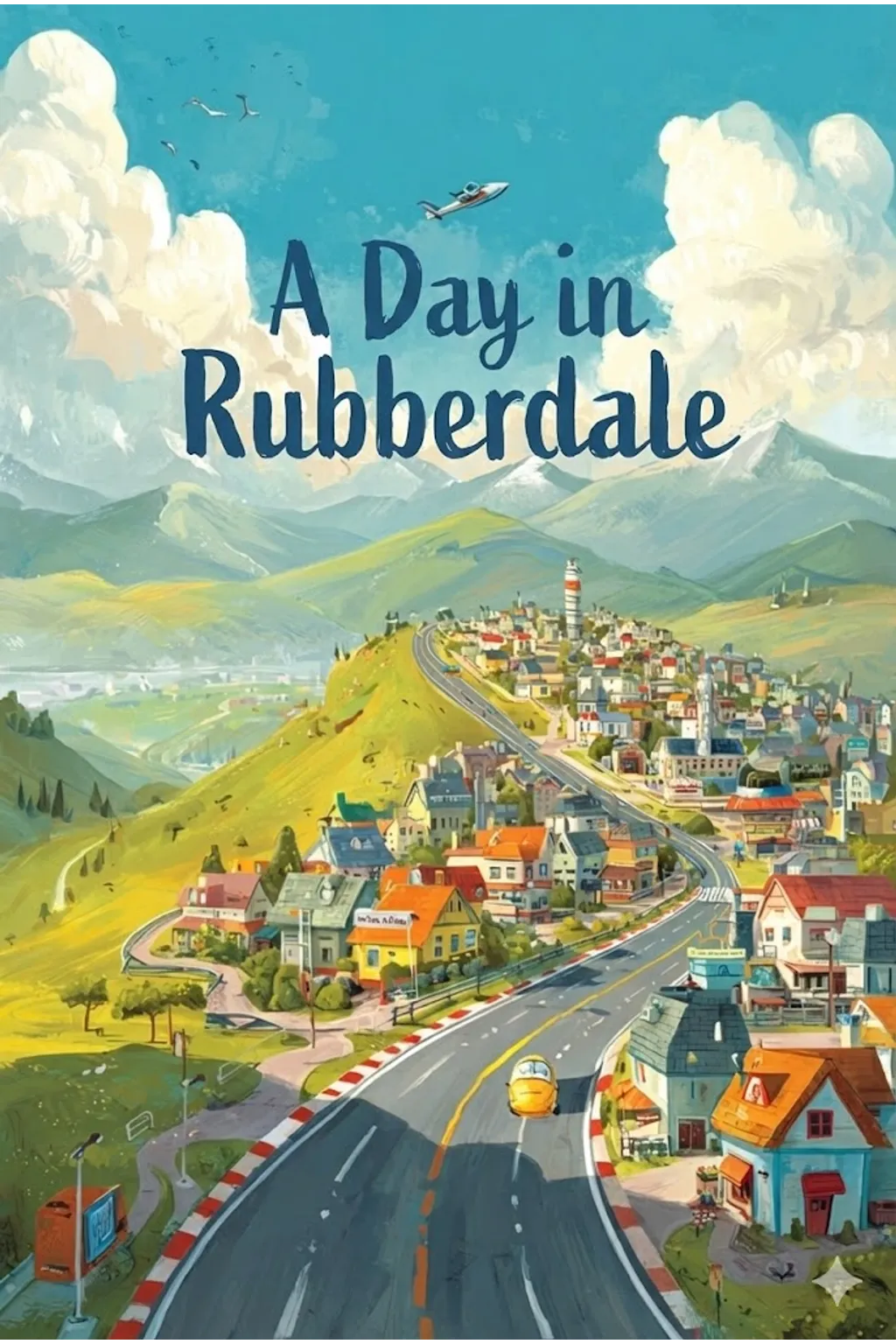
A Day in Rubberdale
An open-ended, child-led adventure where your child gets to decide what happens next, again and again. Some nights it's silly. Some nights, like this one, it opens a window into something real.
If you are trying a play-therapy inspired story for the first time, don't be surprised if your kid is initially hesitant to answer the question "What do you think happens next?" Just hold space, and say something like "It's hard to come up with a story idea! Sometimes I have to think for a while until I have a good idea. But I trust that you will come up with something." This is called "returning responsibility" to your kid. If they are really struggling to generate an idea, you might offer them three options.
You don't want them to become frustrated to the point that they no longer want do the story together, but you do want to let them sit in a small amount of discomfort while they come up with their own ideas. If the first time is challenging for them, the next time will be easier.
Over time, you might notice your kid coming up with wilder and wilder suggestions, which is a sign of increasing confidence... or you might also find they use it to tell a story like my daughter did: to tell you something they don't quite have the words for yet.
WHAT PLAY-BASED STORYTELLING CAN DO
“Sometimes the most important conversations start with a story, not a question.”
Wanderly's play-therapy-inspired stories are built to be exactly this kind of space, one where your child leads, and you follow, and every now and then, something surprising and true comes to the surface.