
How Are You Feeling?
Printable Emotion Chart
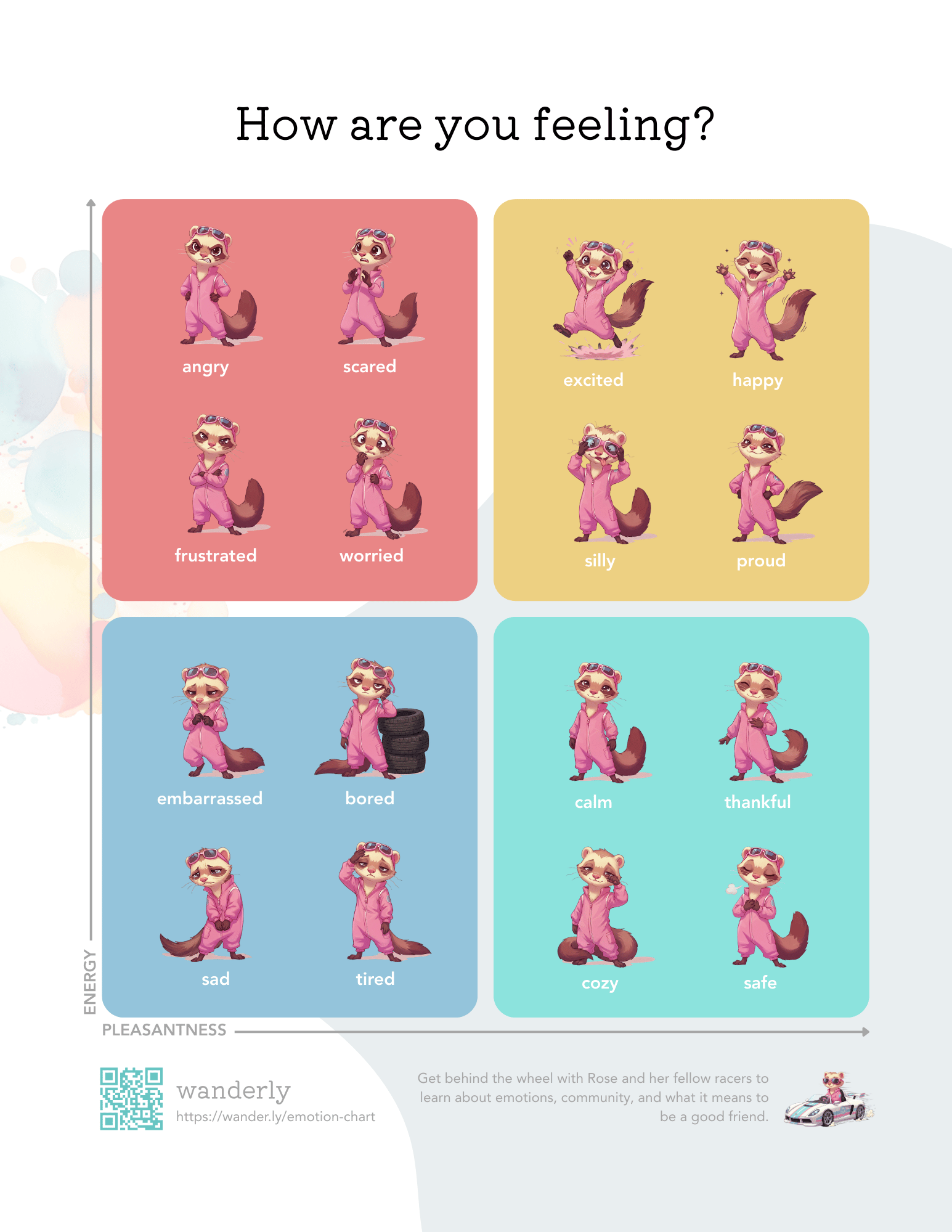
A visual chart that maps 16 emotions across two axes — energy level and pleasantness — giving children a concrete, non-judgmental way to identify what they're feeling in the moment. Featuring Wanderly characters in each emotional pose.
- Covers 16 core emotions across 4 quadrants
- Based on the circumplex model of affect
- Designed for ages 3–10, including non-readers
- Great for daily check-ins, bedtime, or after big moments
Choose your character
Want a version that lasts longer than a printout?
We offer this chart as a high-quality canvas print or framed poster in our Etsy shop — made to go up on a bedroom or playroom wall and stay there. Laminated printouts are great; something you've chosen and hung up sends a different message.
The psychology behind it
The circumplex model of affect — Russell, 1980
This chart is grounded in one of the most replicated findings in emotion science: that all human emotions can be reliably organized on two independent dimensions — how pleasant or unpleasant they feel, and how activated or subdued they feel.
In the 1980s, psychologist James Russell proposed that emotions aren't discrete, isolated categories — they exist on a continuous map. One axis runs from unpleasant to pleasant (what researchers call valence). The other runs from low energy to high energy (arousal). This creates four zones, each containing emotions that feel similarly located on that internal map.
This model is now used by the Yale Center for Emotional Intelligence in their RULER approach — one of the most widely implemented SEL programs in schools worldwide. When children learn to place emotions on a 2D grid rather than sorting them into simply “good” or “bad,” they develop a much richer emotional vocabulary. “Calm” and “happy” both feel pleasant — but they feel very different, and responding to each requires different support.
For children who struggle to name feelings — common in anxiety, autism, ADHD, and early childhood generally — a visual spatial anchor like this chart provides a scaffolded entry point that doesn't require verbal precision. They can point before they can name.
How to use it with your child
Print and display it somewhere accessible. Many families laminate the chart and put it on the fridge, at the dinner table, or in a child's bedroom. The goal is visibility — the more often children see it, the more naturally they'll reach for the vocabulary.
Use it as a check-in, not a quiz. Ask your child to point to where they are on the chart right now. Try it at bedtime (“where did you end up today?”), before school (“how are you going in?”), or just after something big happened. This works especially well because pointing removes the pressure of having to find the right word.
Use it yourself too. When parents use the chart to name their own feelings — “I think I'm feeling a bit worried right now, do you see worried?” — it normalizes emotional awareness and shows children that adults have feelings too.
Don't correct the answer. If your child points to “silly” when you think they might be anxious, stay curious rather than corrective. “Oh, silly! Tell me about that.” The goal of the exercise is connection and communication, not accuracy.
A tip from Laura, Wanderly's founder
When I first introduced this chart to my three-year-old, she looked at the left side (all the worried, angry, and frustrated feelings) and said, “I don't like it.”
I had a split second to decide how to respond. Instead of reassuring her that those feelings weren't so bad, I said: “You know what, those ones are actually really important. The chart isn't telling you that you have to feel that way. It's here so that when you do feel that way, you have a way to show me. No feelings are bad feelings. They're all just ways of letting me know what's going on inside.”
She was quiet for a moment. Then she walked up to the chart and pointed to “worried.” Turns out something had been on her mind all week that she hadn't known how to bring up. That's exactly what the left side of the chart is for.
Her instinct to push the unpleasant emotions away is one of the most common things I've seen in kids and in adults. Reframing the chart from a feelings map into a communication tool seemed to change something for her. It wasn't about having those feelings; it was about knowing she could tell me.
What to watch for
This tool supports emotional literacy — it's not a diagnostic instrument. Two patterns are worth bringing to a professional if they appear consistently over several weeks:
- High-energy unpleasant(angry, scared, frustrated, worried) — persistent elevation here can indicate anxiety, hypervigilance, or chronic stress. If your child seems unable to come down from this zone even in safe, calm settings, that's worth exploring.
- Low-energy unpleasant(sad, tired, bored, embarrassed) — these emotions are normal in small doses, but if your child consistently lands here and has difficulty accessing the pleasant quadrants at all, that can be a sign of depression, withdrawal, or low self-worth.
If naming emotions triggers distress rather than relief, or if your child refuses to engage with the chart entirely, those are also signals worth discussing with a pediatrician or child therapist.
Take it further in the app
The emotion chart helps children name feelings. Wanderly stories help them practice navigating them. Browse stories that build emotional literacy directly: