


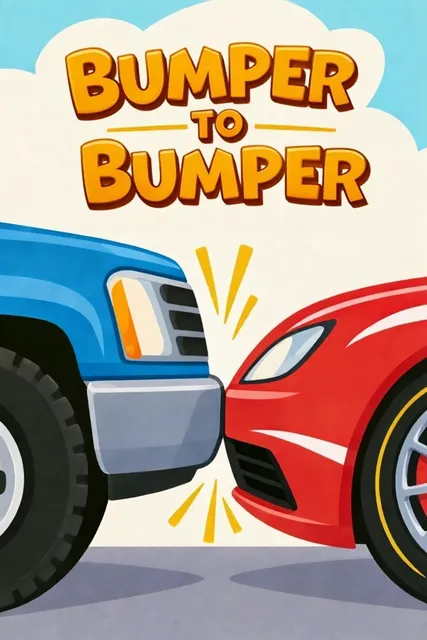
Bumper to Bumper
It is line-up time at the Training Ground, and everybody has a spot. Except somebody is in your racer's spot, and that is not fair at all. You say it kindly, and it does not work. So what do you do with a feeling that big, and what do you try next?
About This Story
What your child will experience
In Bumper to Bumper, your child pilots their chosen racer through a morning at the Rubberdale Training Ground, where every racer has a painted, numbered box in the line and a board says who lines up where today. Your child picks what goes wrong: somebody is parked in the front spot on their day at the front, somebody slides into their place, or somebody keeps bumping into them from behind.
Then comes the moment every young child knows. The urge to yank the other racer out of the spot. Your child chooses kind, factual words instead. When the words do not get through (which happens often at school), and the anger arrives for real. Their racer names the big feeling, settles it, and tries again in a way that actually reaches the other racer.
Why this approach helps
Line trouble at this age is rarely about sharing. It is about fairness, and it comes with a lot of righteous heat: it is MY spot, it is MY day, that is the rule. This story takes that seriously rather than talking a child out of it.
It practices five things that matter most:
Assuming positive intent. The first words out are never an accusation. Not "You cut me!" but "I think this is my spot" or "Oops, your spot is number four." The other racer genuinely does not know at first, so the friendly read is the accurate one.
Keeping it small and factual. One situation, right now, in a sentence. No history, no verdicts about what the other racer is like.
Checking that the message arrived before deciding what it meant. The first reminder does not land, because the other racer cannot hear it over a revving engine. So the next move is to make it arrive: say it again where they can see and hear, or point at the board. This is the step many children skip.
A no is not the same as being mean. If your child chooses to have the other racer decline, they are not choosing a villain. They are choosing a racer who likes being at the front, or who wants to stay near a friend, or who says "okay!" and then keeps bouncing forward anyway. That is the honest part of the story, and it is where a child gets to practice the hardest idea in it: you cannot make somebody else move, and you can always choose what you do.
Asking a grown-up without tattling. Boris gets a three-part recipe that is worth borrowing at home: here are the facts, here is what I already tried, can you help me? Nobody gets in trouble. It is a request for help, not a report on someone's behavior. Notice that Boris arrives late on purpose. Asking for help lands differently once a child can say what they already tried.
Critically, the calming and the kinder thoughts always come before your child picks what happens next, both times, so the lesson lands on every path.
What to notice as a parent
Which trouble your child picks is a window all by itself. Spot disputes and body-space trouble often feel very different to the same child.
Which words they choose, how they settle the feeling, and what they end up asking Boris for are all worth watching. Both of the asks are good ones, and the story treats them that way.
If your child wants to talk after, a simple opener works well: "Has somebody ever been in your spot in line? What did you do?" The phrase teachers often use for the body-space version is space bubble, and it fits neatly onto the painted box in this story.
Personalize This Story
Make this story truly special by adding these details:
- ✓Pick a racer.
Story Questions
Questions your child may be asked while creating this story:
- What happened when the main character got to the line?
- What did the main character say to the racer in their spot?
- What did the main character feel when nothing changed?
- How did the main character help the big feeling settle?
- What did the main character do next?
Loved by Families
Join thousands of happy families who've empowered their children with personalized, interactive stories.
GET STARTED
Ready to hear what your child has to say?
Join thousands of families who've used Wanderly to engage their child's imagination, to practice important skills, and to build confidence. Download the app today.

